

On 17 June 2026, the network operator Transgrid, published a letter informing data centre proponents that Sydney’s transmission was at capacity. And the only salve offered to the now stalled data centre projects is to wait for new network augmentation and transmission, predominately in the form of the Sydney Ring South project.
Let’s for a moment challenge this position of ‘build first, connect later’.
A study funded by Google of PJM’s transmission network by Camus, encoord and Princeton University found a 500 MW data centre can connect in 2 years; three to five years faster by using a flexible connection and bring your own capacity (BYOC).
A closer look at the US model
The model has two components.
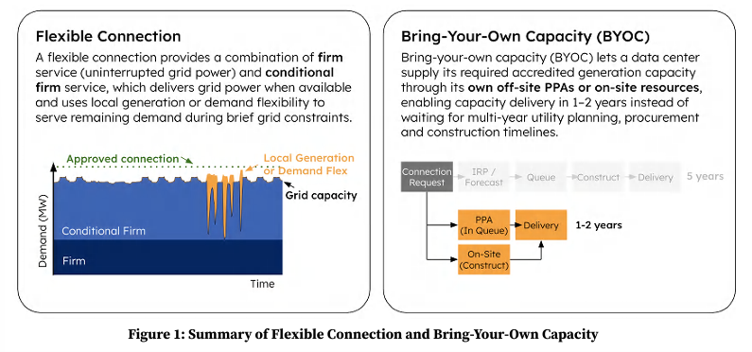
A flexible grid connection offers the data centre firm (uninterruptible) service for most of its load requirement, and conditional service – where a portion of the load uses grid power in normal conditions and relies on on-site or co-located resources during limited periods of system stress.
The BYOC mechanism ensures the data centre directly procures accredited capacity through power purchase agreements, virtual power plants or on-site resources such as behind-the-meter storage or gas or diesel gensets.
Image: Summary of Flexible Connection and BYOC 1
In Australia, PPAs and on-site resources for data centres are broadly understood, what perhaps needs further explanation is what a virtual power plant (VPP) can do.
VPPs aggregate distributed energy resources such as batteries, EV chargers, and flexible loads to provide dispatchable capacity at scale. In Australia this could be achieved at the distributed network services level, such as with Ausgrid, Endeavour Energy in Sydney, or Citipower and Jemena in Melbourne.
The crucial difference is in the United States’ PJM network, which coordinates the movement of electricity through 13 states, a VPP is accredited to provide capacity and ancillary services. And this regulatory response has enabled providers such as Voltus, Tesla and Sunrun to bring the product to market.
The study results are striking.
Grid power was available for more than 99% of all hours. On-site resources (e.g. batteries, generators) were dispatched for just 40-70 hours per year. Transmission constraints produced 7-35 hours annually, with events lasting 4-16 hours and generation shortfalls added ~32 hours per year2.
The other key finding was flexible grid connections and BYOC significantly reduce and internalise incremental supply costs. Used together, the mechanism mitigates new system buildout and shifts remaining costs onto the data centre, instead of consumers.
How can this model be used in Australia?
Unfortunately, the bring your own capacity component of the model cannot be replicated in Australia. It requires an accredited capacity product and the NEM does not have one.
Interestingly the Nelson Review’s final report published in December 2025 recommended against creating capacity markets (Recommendation 1B), arguing the NEM’s cap contract market already functions as a decentralised capacity market. All federal and state energy ministers – except for Queensland – have agreed in-principle to the Review’s core recommendations.
But for Sydney, the constraint is a lack of transmission not generation. So then, what if TNSPs were willing to write a different connection agreement?
Flexible connections for customers are already occurring, just not for data centres.
NSW’s largest electricity consumer, Tomago Aluminium draws a constant ~950 MW which is around 10% of NSW energy supply, and it has a curtailment capability written into its electricity supply arrangements since 2017.
It will be one to watch with interest as NSW has not yet connected a 100 MW+ data centre into its transmission network so it is unclear what curtailment, or ‘flex’ is going to be negotiated.
Where the VPP fits in
Australia is mandating data centres to procure their own capacity without an offer in return.
Could formalising a VPP be the answer to the one-sided trade – and give data centres a genuinely accelerated path to electrons?
The good news is as of March 2026, Australia has 25.5 GW of rooftop solar across 3.8 million households and businesses.3
FTB analysis shows a 100 MW data centre with roughly 700—790 GWh annual draw against rooftop solar ~15% capacity factor requires in the order of 530-600 MW of aggregated rooftop solar – tens of thousands of households – and shaping that output means shifting about two-thirds of the energy through home batteries of 10-13 kWh each.
Using the United States precedent, a data centre funding a ‘suburb’ of household solar and batteries can plausibly count towards bringing additional renewable generation and firming the ECMC offset mandate and Office of AI require of data centre proponents.
And therefore, a connection agreement could be negotiated in which the data centre commits to curtail to a defined MW level during network peak events, with the curtailment event offset by VPP and on-site battery storage and generation resources.
Why the network is not offering this
Data centres themselves would need to propose this option as it may not align with TNSPs commercial interests. Augmentation is revenue and a flexible connection that avoids augmentation reduces the opportunity to grow the regulated asset base.
The United States solve came by way of a mandate from the regulator. In December 2025 FERC found PJM’s tariff unjust and directed it to establish new transmission services for co-located loads, including a non-firm contract demand service. In June 2026 FERC extended the pressure to all six grid operators, ordering them to justify or reform tariffs that lack service options for flexible large loads4.
What this means for investors
So for the data centres parked in Sydney, and to an extent in Melbourne, this is the rule change proposal they should be advocating to the Australian Energy Regulator.
A conditional-firm connection rule change would reprice the connection for any metropolitan data centre who can deliver a PPA, VPP and on-site storage and generation.
For the 15 data centre projects named in NSW Investment Delivery Authority’s endorsement, sponsoring that rule change is a viable option as opposed to waiting over a decade for Sydney Ring South to be energised or shifting to other investment proposals such as converting the land acquired to new-build industrial commercial property.
And remember – there is technically no connection ‘queue’. It is an open access network and the first data centre to get that connection agreement signed secures electrons to their data centre.
With each MW of capacity representing between US$4 million and US$12 million in annual revenue – we’d say that is pretty important5.
FTB Energy Research maintains the data that sits behind this article. If you are pricing a co-located BESS or seeking advice on pursuing an alternative path to power, this is the work we do privately: info@followthebottleneck.com
Not investment advice. This article uses public information only and its content is general in nature.
CAMUS, encoord, Princeton University: Flexible Data Centres: A Faster, More Affordable Path to Power, December 2025
ibid
CAMUS, encoord, Princeton University: Flexible Data Centres: A Faster, More Affordable Path to Power, December 2025